

Diagnose the System Before Replacing the Leader
Replacing a leader is one of the most visible decisions an organization can make. It signals action, accountability, and forward momentum. But in many cases, it’s also a misdiagnosis.
Leaders don’t operate in a vacuum. They are hired not just to execute, but to build and manage the structures that enable performance—decision-making rhythms, accountability mechanisms, and team dynamics. When those structures are misaligned, even the strongest leaders will struggle.
This is becoming more evident as we move into 2026. Boards are prioritizing agility, adaptability, and emotional intelligence over traditional markers like tenure or pedigree. On the surface, that sounds like a hiring shift. In reality, it’s a systems challenge.
Because you can’t hire your way into leadership capability.
Capability is built through reinforcement, clarity, and intentional design. Yet many organizations still rely on resumes and past titles, expecting new leaders to deliver different outcomes inside unchanged systems. The result? Frustration, underperformance, and eventually, turnover.
6 Steps for Evaluating Your Leadership System
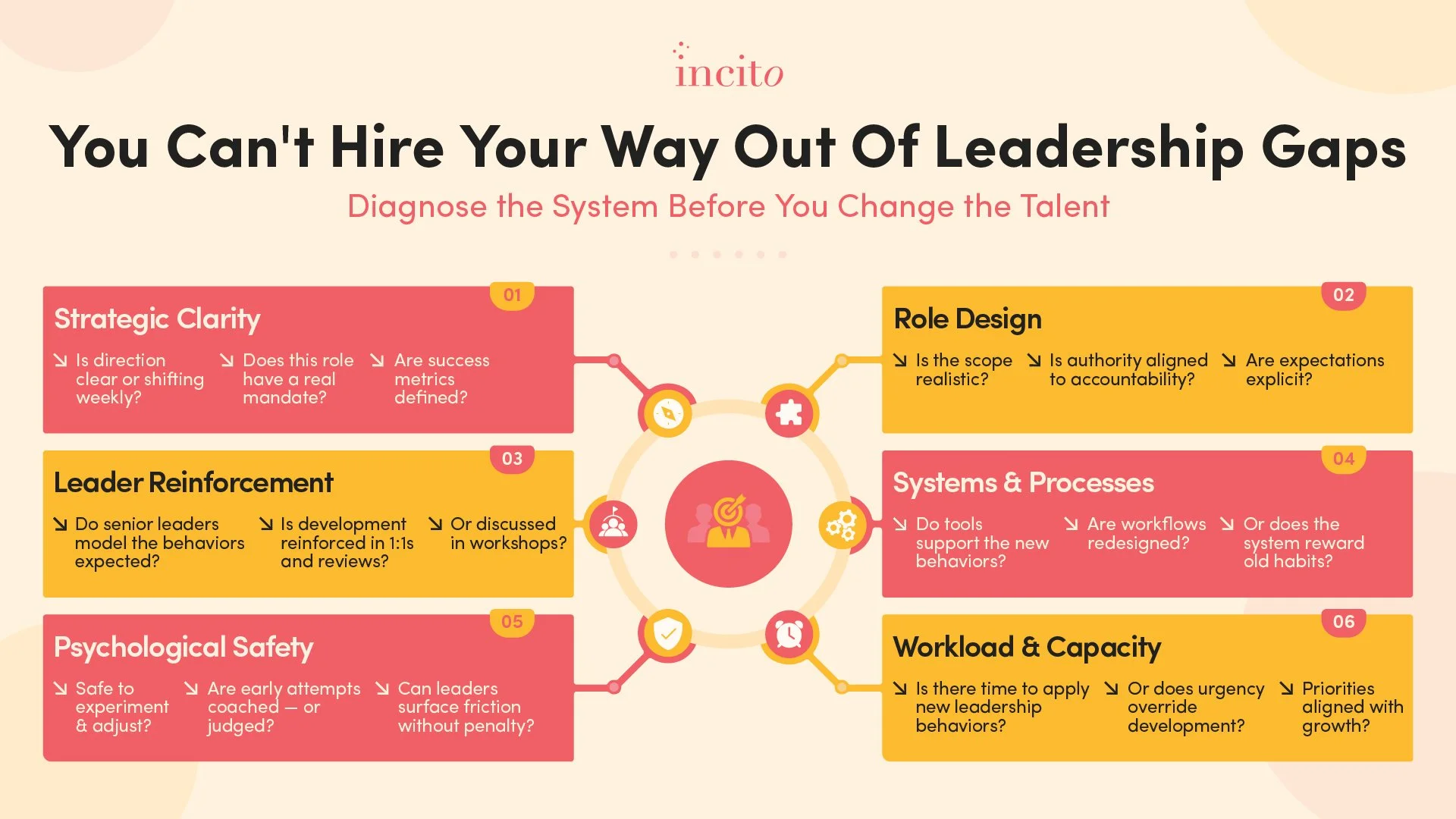
Before you replace a leader, step back and assess the system they’re operating in. These six factors will help you diagnose what’s really blocking performance:
Strategic Clarity
Is direction clear or shifting weekly? Are success metrics defined in a way that leaders can act on? Too often, leaders are held accountable for outcomes without a stable or coherent strategy. If priorities are constantly evolving or poorly communicated, performance issues are inevitable.Role Design
Is the scope of the role realistic? Is authority aligned with accountability? Leaders can’t deliver results if expectations are vague or if decision rights are unclear. Misaligned roles create friction, slow execution, and erode confidence across teams.Leader Reinforcement
Are senior leaders modeling the behaviors they expect? Is leadership development reinforced in real moments like 1:1s, reviews, and day-to-day decisions? If development only shows up in workshops, it won’t stick. Leaders need consistent signals about what “good” looks like.Systems & Processes
Do your tools and workflows support the behaviors you want, or reinforce old ones? Many organizations try to drive new ways of working through legacy systems. If processes reward speed over quality, or individual output over collaboration, leaders will default to those patterns.Psychological Safety
Can leaders experiment, adjust, and surface friction without penalty? Early attempts at change are rarely perfect. If those attempts are judged too quickly, leaders will retreat to safer, more familiar behaviors – undermining transformation efforts.Workload & Capacity
Is there actually time to lead differently? Or does urgency override development every time? Leaders can’t build new capabilities if they’re constantly in reactive mode. Capacity isn’t just about workload. It’s about whether priorities are aligned with growth.
Build the System, Not Just the Leader
The organizations getting this right are shifting their mindset. They’re treating leadership capability as infrastructure, not an individual trait. They’re redesigning how decisions get made, how leaders are supported, and how performance is reinforced.
This doesn’t mean hiring isn’t important. It is. But hiring alone won’t solve systemic gaps.
In 2026, the question isn’t just who you hire.
It’s whether the system around that leader will actually develop the capability your strategy demands.
Before you make a change at the top, ask yourself: Does your system enable your strategy, or is it quietly working against it?